Pages

Showing posts with label Assessment and Evaluation. Show all posts

Friday, October 3, 2014

Feeling Fit: Monitoring Intensity Levels

 
P.A.C.E. Model for Self-Monitoring Cardiorespiratory Endurance
 
Students ran in the Terry Fox Run but also the 12 Minute Run.  Junior/Intermediate students monitored how hard they were working using the P.A.C.E. Model that I came up with above. Students found their OWN pace that allowed them to move at a continuous pace with a partner.  The monitored their PACE using the talk test and breath sound check.
 
Rate of Perceived Exertion: Primary-Junior
Junior-Intermediate Students participated in the Beep Test where they will then decide what distance will allow them to gradually increase intensity.  They will decide on the distance to run - 10 metres, 15 metres, or 20 metres.

Sunday, September 28, 2014

Positive Attitude in PE

Love this poster I found on Pinterest! Great visual to reinforce that Physical Education works, the body, brain, and being!  Just changed the words to fit PE.

We just finished our cooperative games unit and had the students "T.A.G." another during our team games to get them thinking about interpersonal skills (cooperation, team work, fair play) and personal skills (monitoring self (i.e., stop, start on a signal, safe participation following simple game rules, safely staying in set boundaries))...etc.

Cooperative Games: Getting to know my students at my new school, Dr. Davey in Hamilton, Ontario. 

Exit Card: T.A.G. and Evaluate enjoyment level
Students selected the team games they enjoyed them most...love bingo dabblers for quick assessments!


Friday, February 21, 2014

Winter Olympics 2014 in Phys-Ed

We are learning to participate safely in a variety of Olympic Activities.
We are learning to work cooperatively in small groups while enjoying unique activities in Phys-Ed.

Olympic Oath, Motto, Teams

Olympic Events for PE


Olympic Hockey Using Two Large Pool Noodles and 1 Noodle Disc

Olympic Biathlon Target Station

Olympic Curling using Bean Bags

Olympic Luge using Scooters Boards and Pylons

Olympic Figure Skating using Paper Plates and Pylons with Locomotor Prompts.

Thursday, October 3, 2013

Gr.7-8 Passport for Life Pilot Letter to Parents

HomeAttention Lawfield Parent/Guardians of Ms. Merritt grade 7/8 students (Mrs. Fallon's class) (letter from Passport for Life Website):

Your grade 7/8 Students will be participating in Passport for Life.  This initiative, developed by Physical and Health Education Canada (PHE Canada), supports the development and advancement of physical literacy (explained in link) among students. The goal of physical literacy is to support all individuals in their ability to move with competence and confidence in a wide variety of physical activities and environments. 
Physical Literacy explained definition
Passport for Life is an online program which will be used to gather information about your child’s level of physical literacy. Passport for Life is an online program which will be used to gather information about your child’s level of physical literacy. To learn more about Passport for Life and strategies to help your child improve their physical literacy visit the Information for Parent section of the website. 


Your child’s Passport for Life results are not equivalent to their Physical Education grade, however, the teacher will use this information to provide individualized help for students to set goals and work towards continued improvement. Parents play a critical role in helping children develop physical literacy. As your child uses Passport for Life, you can expect your child’s teacher to involve you in helping him or her to set realistic and achievable goals. 

The Passport for Life Program includes: 
 tools to assess student levels of physical literacy, 
 guides to help interpret results, 
 ideas and resources to help your child’s teacher improve the physical literacy level of your child, 
 connections to the mandated health and physical education programs in your jurisdiction, and 
 resources and connections to further knowledge and competence. 

The program is divided into four key areas: 
 Active Participation: Includes involvement in activities within school and beyond, both 
organized and unorganized. Children and youth should experience activity in a variety of 
environments, such as on land, on ice and snow, in water and in air. 
 Living Skills: Those skills associated with making healthy active choices that are both beneficial to and respectful of their whole self, others and their environment. 
 Fitness Skills: Include balance, muscle endurance and cardiovascular fitness (stamina). 
 Movement Skills: Include throwing, jumping, and running—the building blocks of more complex skills used in games, activities, sports and leisure pursuits. 

The information collected will also inform overall regional and provincial levels of physical literacy in order to monitor improvements over time and to assist in understanding what other resources or interventions may be needed. Please be assured that all data collected through this initiative will be anonymous and will reflect a compilation of all data (not individualized). 

Please feel free to contact me should you have any questions or concerns. 

Sincerely,

Ms. C. Merritt


Friday, September 20, 2013

"T.A.G. You're It" Peer Assessment

Another way to encourage students to be accountable in H&PE through peer assessment.

Junior and Intermediate Lawfield students found a partner to work with at the start of class.  We introduced a variety of activities that promoted small group (pairs) work.  We also introduced some Physical Literacy Charts from Thompson publishing and discussed how to give feedback when viewing their partner performing the Perfect Practise: Learn to play charts


T.A.G. You're It Peer Assessment Anchor Chart
***Found this amazing idea on Pinterest and can be found at "Classroom Freebies Too"

I adapted the wording to work in Health and Physical Education!  Fun way to get them thinking!!!

F56 Peer Evaluations

T.A.G. EXIT CARDS: Students will eventually fill out an Exit Card: Self Evaluation (see below for BLM).
T.A.G. You're It:  Self Evaluation


Friday, June 14, 2013

Primary Self-Evaluation Exit Cards

Let's make our students' learning visible!  If your learning goal for the day is to participate at a moderate to vigorous level, have students tell you what active participation looks and sounds like.


Daily Learning Goal:  We are learning to be active participants.
Success Criteria: (Grade 1's came up with these)
I can hear my self breathing.
I can feel hot.
I can see sweat.
I can make my feet move.
I can feel my heart beating faster.
I can move around the space safe.

Have students select the levelled paper they thought they were for that day. They fill out this exit card by putting their name at the top and draw a picture of what they did well according to the success criteria (using pictures and words).

Daily Learning Goals: What do each of these look like in your class on a daily basis (based on your Unit Learning Goal)? 

 Allow students to co-construct SUCCESS CRITERIA.

Thursday, May 2, 2013

Striking-Field TLCP: Intermediate

The TLCP outline for this unit was created with the needs of the students in mind at my school.  A big concern is the fact that students are still becoming accustomed with playing games and activities according to the Teaching Games for Understanding (TGFU) model.  The intermediate students still have a 'sport specific' mentality.  During this unit they were exposed to a variety of games...Change takes time for all of us :)

BIG IDEA:
Gr. 7: How do we safely and fairly devise and experiment with different strategies for better results in game situations?

Gr.8: How do we encourage others to participate safely and fairly in physical activities while experimenting with different rules?

LEARNING GOAL:
We are learning to understand the components of striking and fielding activities and apply sending and receiving skills and strategies while safely participating in games, while including others.
Striking-Fielding TLCP  (Daily Learning Targets are Listed in the Middle)
DAILY LEARNING TARGETS (Grade 7):
  1.  We are learning to follow and enforce proper safety guidelines to keep me and others safe.
  2. We are learning to make changes to games to include others and make it enjoyable.
  3. We are learning to strike a ball and shift my weight as I contact the ball and follow through in the intended direction to send it between or over opposing players.
  4. We are learning to hit or kick in different ways, varying the distance the object is sent, so that it wall be more difficult for opponents to field and return the object.
  5. We are learning to understand the basic game structures, rules, and guidelines of striking and fielding games.
  6. We are learning to apply the skills and strategies in striking and fielding games.
Learning Target #3: Movement Competence Striking Success Criteria (Generated by the students)
Use Ophea Resource from Gr.7 Striking-Fielding Lesson
Rubric generated using Learning Targets

FINAL TASK:

Application: 
You will participate in modified games of Striking and Fielding.  As you participate you will apply/demonstrate strategies and skills taught during the unit and demonstrate your safe and fair play.  As a team you will change up one rule from the original game of baseball and decide what strategies (offensively as the batter/base runner; defensively as the fielder).

Communication/Thinking & Inquiry:
·       You will complete an exit card to communicate your safe participation how you participated safely during striking/fielding games.
·       You will also complete a rule change and a strategy that you could working on connecting to the rule change you selected.

knowledge/Understanding:
·       On your exit card, you will explain your knowledge and understanding of the basic rules or components of striking and fielding games. 
Striking-Fielding Exit Card with Rubric Attached: Students

Wednesday, February 27, 2013

Invasion Games-Intermediate: Two Stars and a Wish

"Two Stars and a Wish" or "Two Hoops and a Swish"

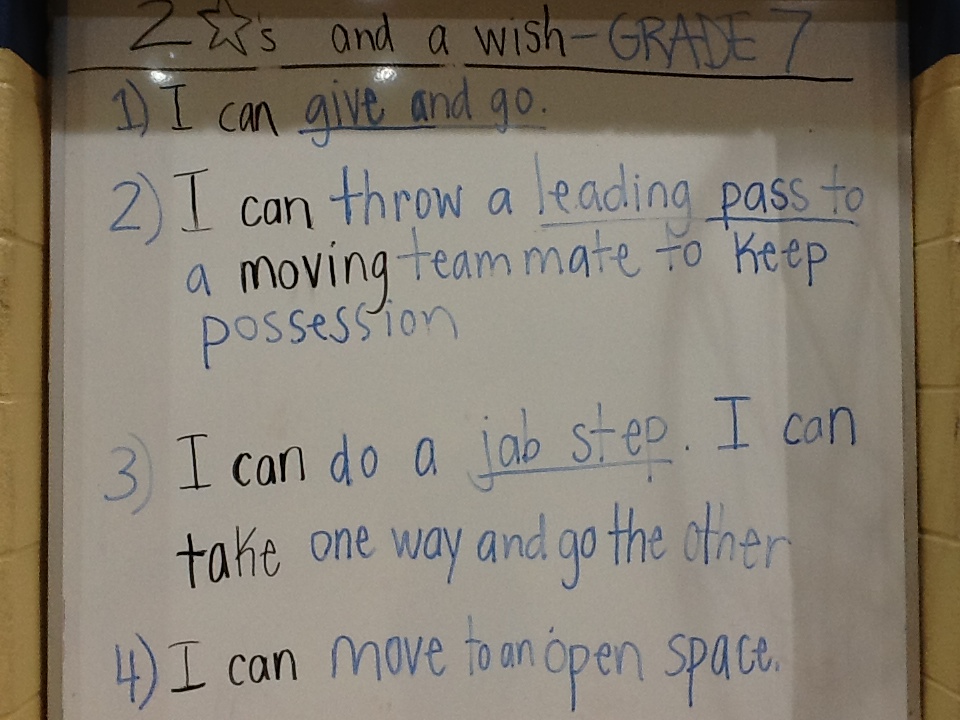
Grade 7 & 8: I made a list of strategies we were working on during our indoor Invasion Territory Unit. These are from the H&PE Ontario Curriculum.


I modelled the 3-4 strategies (see pictures above), specific to the grade being taught and had students evaluate me using thumbs up, side, or down when I performed each strategy.  I  demonstrated the strategies so students could 'evaluate' my strengths (stars or 'hoops') and where my areas for improvement were (wish or 'swish').  They then came up with an overall decision on what my 'wish' should be.

Now at the end of the Invasion Unit, students are deciding what their strengths are in terms of strategies and selecting at least one area they would like to improve (i.e., 'wish or swish') according to their own assessment of themselves.  For example, this unit we have provided students a wide variety of activities to practise and apply taught skills and strategies.  Some activities include scooter hockey, ultimate chicken, scoop ball, soccer, basketball, hoopster, floorball, etc.  

Next Steps:  Students will complete an exit card and critically think about their own strengths and 'wish' at the end of this unit.


Saturday, February 9, 2013

Pyramid-Bean Bag Self Evaluation

Using the Grade 1 Ophea Unit,  "Moving Objects in Space", students were finding ways to successfully catch their bean bags.  We worked through different individual throw and catch challenges and reviewed how to successfully receive their equipment".  Student were told they were to self-assess their safe and active participation using the pyramid chart and their own bean bag.  We reviewed how to be safe when moving with their own object and we talked about how to persist when a challenge gets tough.  The most important aspect is to allow student to find their own success.  That might mean they don't throw their bean bag as high or they still might need to use two hands to receive and are not ready to receive with one.

Some Critical Questions asked during the lesson:

1.  Teacher prompt: "What is a strategy?"  Students had a hard time trying to describe this so it will become one of my 'words of the month' and we will to their understanding on an anchor chart.

2. Teacher prompt: “What made it challenging to receive a beanbag and what could be done to make this task easier?”

Self-Evaluation:


Tuesday, January 8, 2013

S.T.A.R.S and A&E

Daily Physical Activity:  Encouraging kids to be active on a daily basis, while demonstrating positive character traits.  Be S.T.A.R.S. in H&PE!


Friday, October 19, 2012

Net/Wall Activities and TLCP

*HPE Program Need:  Increasing critical thinking and allowing more student opportunities to speak the H&PE language using appropriate terminology in their thinking and communications; increasing student voice; allowing students to experience activities using a variety of equipment, playing a variety of games to reinforce strategies discussed.

Critical Thinking Questions for Net/Wall Games
*Critical Thinking Questions generated from Ophea's "Learn to Move - Fundamental Movement Skills" Cards (Net/Wall Card) or from Ontario H&PE Curriculum (look in specific grade under teacher prompts or living skills at the front of each grade section).
Posted in gym hallway during unit
*Can be used as exit card questions
*Allows students to be thinking about application when playing a variety of net/wall games and activities.

Net/Wall Activities-J/I Movement Competence Critical Thinking Questions

Net/Wall Activities-J/I Living Skills Critical Questions

Teaching Learning Critical Pathway for Net/Wall Activities (Junior/Intermediate)


Net/Wall-Junior TLCP


Net/Wall-Intermediate TLCP
Big Idea:
Intermediate Big Idea: How does failure allow you to gain success over your opponent in Net/Wall Activities? 


Junior Big Idea: How can you be a good example to others when participating in new and challenging net/wall games and activities?

Learning Goals: Linked to specific grade expectations in Living Skills, Active Living and Movement Competence Strands.

Tasks: (Basic ideas for students to demonstrate their learning) 1. Video conference with students (pre-assessment) using critical thinking questions based on living skills. 2. Movement Competence skills break down (demonstration and oral). 3. Application of grade specific strategies in net/wall activities. 4. Students completed a self-evaluation (included safety and active participation for progress reports).

Bump It Up: Focus on Strategies and their application in a game situation (this is a need in our classes this year).

Evaluation: Rubric included a student self-evaluation and an exit card question at the bottom (based on our critical questions).


***What are some of your 'Big Ideas' for Health & Physical Education?***


 It would be nice to gather some HPE big ideas that can be cross-curricular and even link to what teachers are doing in literacy!


Monday, September 17, 2012

Movement Competence-Self/Peer Evaluation Poster

Movement Competence Evaluation Chart-Self/Peer Eval
1. Decide what your learning goal focus is for the lesson(s).  Have students help generate the success criteria according to the learning goal selected.
2.  Write success criteria with dry erase marker (laminated poster paper) into the white middle area of the poster.
3. At the end of the lesson(s) have students monitor and give you, the teacher, feedback if the students feel they 'got it' or 'are still working on it' according to the success criteria listed.
4. Each student receives a square with Velcro and attaches it to poster Velcro for quick, instant feedback.

Monday, September 10, 2012

Assessment Target

Assessment Pyramid
Self-Evaluation using Learning goal and success criteria.  Students will come up with additional success criteria to support the learning goal.

Friday, September 7, 2012

Assessment Anchor Charts

TRAFFIC LIGHT ASSESSMENT 

If your school board subscribes to Ophea H&PE Curriculum Resources: Grades 1-8! and click on grade 1, 2, 3then you can go to Assessment, you will find this resource.  Ophea.net has many more ideas and supports as well! (SEE PICTURE BELOW)


 ASSESSMENT TARGET

I cut up small pieces of thick card-stalk (individual assessment square) and placed velcro dots (from the dollar store in the sewing section or you can cut up strips of velcro) on the back (fuzzy) and then place the rough part of the velcro onto the actual target (see below).  I placed the loose pieces into a zip-lock bag and attached it to the laminated anchor chart.

- Junior / Intermediate Assessment Target 
-Provided a learning goal at start of class. 
- Students help generate success criteria that is related to the learning goal.
- Self-assessment: students place an 'assessment square" where they think they should be on the target (level 1, level 2, level 3 level 4)
- Kinesthetic learner physically places level onto the chart
(SEE PICTURE BELOW)

Variations:
- Laminate a large piece of yellow card stalk, cut into squares, and have students write their name on their square.  Teacher can record self-eval results.


PRIMARY TARGET ASSESSMENT