Pages

Showing posts with label Teaching Games for Understanding. Show all posts

Wednesday, February 27, 2013

Invasion Games-Intermediate: Two Stars and a Wish

"Two Stars and a Wish" or "Two Hoops and a Swish"

Grade 7 & 8: I made a list of strategies we were working on during our indoor Invasion Territory Unit. These are from the H&PE Ontario Curriculum.

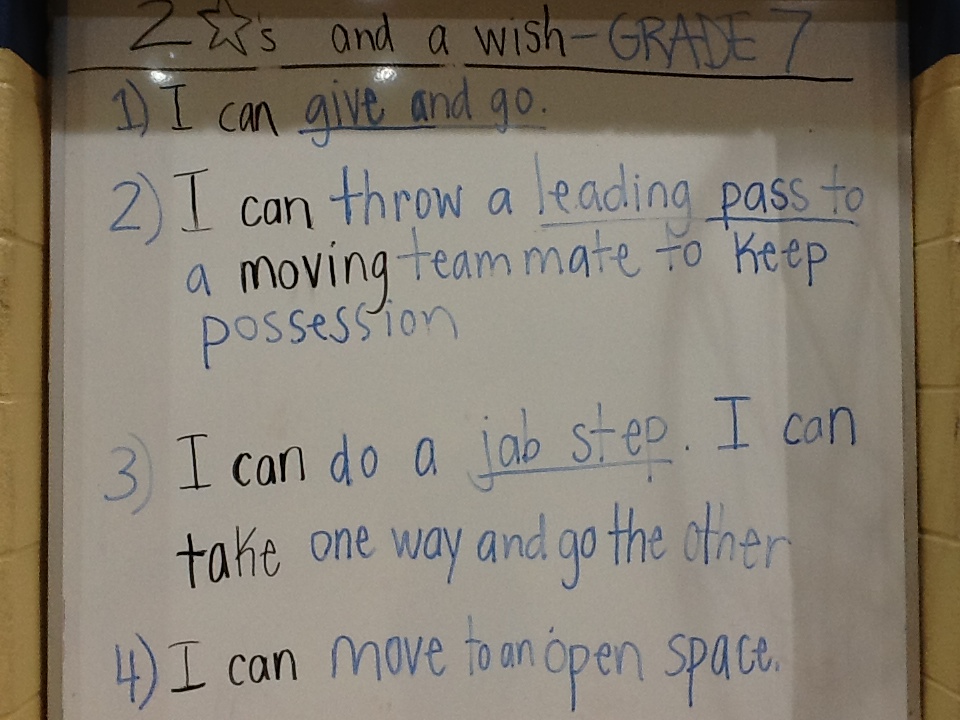


I modelled the 3-4 strategies (see pictures above), specific to the grade being taught and had students evaluate me using thumbs up, side, or down when I performed each strategy.  I  demonstrated the strategies so students could 'evaluate' my strengths (stars or 'hoops') and where my areas for improvement were (wish or 'swish').  They then came up with an overall decision on what my 'wish' should be.

Now at the end of the Invasion Unit, students are deciding what their strengths are in terms of strategies and selecting at least one area they would like to improve (i.e., 'wish or swish') according to their own assessment of themselves.  For example, this unit we have provided students a wide variety of activities to practise and apply taught skills and strategies.  Some activities include scooter hockey, ultimate chicken, scoop ball, soccer, basketball, hoopster, floorball, etc.  

Next Steps:  Students will complete an exit card and critically think about their own strengths and 'wish' at the end of this unit.


Thursday, November 1, 2012

Net/Wall Game Category Defined

Teaching Games for Understanding: 

Net/Wall Game Category Defined, Strategies, and Tactics

We often used mats as 'nets' to play with a variety of equipment including:

For our Junior and Intermediate Classes, we focussed on a specific net/wall strategy and allowed student choice of equipment later in the unit, once we experimented with various boundaries, skill development (i.e., underhand serve, receiving within set boundaries in ready position - Refer to Ontario H&PE Curriculum for specific grade expectations).

Junior/Intermediate Equipment:
- Petekas (send with hand)
- Tennis ball (send with hand)
- Deck Tennis Rings
- Volleyballs
- Trainer Volleyballs
- Badminton (use of implement to send)
-etc.

Primary/Junior Equipment:
- Balloons
- Beach Balls (variety of sizes)
- Bean Bags
- Tennis Balls (wall ball)
- Trainer Volleyball
- Deck Tennis Rings
-etc.

What are some creative ways you played NET/WALL GAMES using a variety of equipment within your division?

Friday, October 19, 2012

Net/Wall Activities and TLCP

*HPE Program Need:  Increasing critical thinking and allowing more student opportunities to speak the H&PE language using appropriate terminology in their thinking and communications; increasing student voice; allowing students to experience activities using a variety of equipment, playing a variety of games to reinforce strategies discussed.

Critical Thinking Questions for Net/Wall Games
*Critical Thinking Questions generated from Ophea's "Learn to Move - Fundamental Movement Skills" Cards (Net/Wall Card) or from Ontario H&PE Curriculum (look in specific grade under teacher prompts or living skills at the front of each grade section).
Posted in gym hallway during unit
*Can be used as exit card questions
*Allows students to be thinking about application when playing a variety of net/wall games and activities.

Net/Wall Activities-J/I Movement Competence Critical Thinking Questions

Net/Wall Activities-J/I Living Skills Critical Questions

Teaching Learning Critical Pathway for Net/Wall Activities (Junior/Intermediate)


Net/Wall-Junior TLCP


Net/Wall-Intermediate TLCP
Big Idea:
Intermediate Big Idea: How does failure allow you to gain success over your opponent in Net/Wall Activities? 


Junior Big Idea: How can you be a good example to others when participating in new and challenging net/wall games and activities?

Learning Goals: Linked to specific grade expectations in Living Skills, Active Living and Movement Competence Strands.

Tasks: (Basic ideas for students to demonstrate their learning) 1. Video conference with students (pre-assessment) using critical thinking questions based on living skills. 2. Movement Competence skills break down (demonstration and oral). 3. Application of grade specific strategies in net/wall activities. 4. Students completed a self-evaluation (included safety and active participation for progress reports).

Bump It Up: Focus on Strategies and their application in a game situation (this is a need in our classes this year).

Evaluation: Rubric included a student self-evaluation and an exit card question at the bottom (based on our critical questions).


***What are some of your 'Big Ideas' for Health & Physical Education?***


 It would be nice to gather some HPE big ideas that can be cross-curricular and even link to what teachers are doing in literacy!


Monday, September 17, 2012

Movement Competence-Self/Peer Evaluation Poster

Movement Competence Evaluation Chart-Self/Peer Eval
1. Decide what your learning goal focus is for the lesson(s).  Have students help generate the success criteria according to the learning goal selected.
2.  Write success criteria with dry erase marker (laminated poster paper) into the white middle area of the poster.
3. At the end of the lesson(s) have students monitor and give you, the teacher, feedback if the students feel they 'got it' or 'are still working on it' according to the success criteria listed.
4. Each student receives a square with Velcro and attaches it to poster Velcro for quick, instant feedback.