Pages

Showing posts with label Success Criteria. Show all posts

Thursday, May 2, 2013

Striking-Field TLCP: Intermediate

The TLCP outline for this unit was created with the needs of the students in mind at my school.  A big concern is the fact that students are still becoming accustomed with playing games and activities according to the Teaching Games for Understanding (TGFU) model.  The intermediate students still have a 'sport specific' mentality.  During this unit they were exposed to a variety of games...Change takes time for all of us :)

BIG IDEA:
Gr. 7: How do we safely and fairly devise and experiment with different strategies for better results in game situations?

Gr.8: How do we encourage others to participate safely and fairly in physical activities while experimenting with different rules?

LEARNING GOAL:
We are learning to understand the components of striking and fielding activities and apply sending and receiving skills and strategies while safely participating in games, while including others.
Striking-Fielding TLCP  (Daily Learning Targets are Listed in the Middle)
DAILY LEARNING TARGETS (Grade 7):
  1.  We are learning to follow and enforce proper safety guidelines to keep me and others safe.
  2. We are learning to make changes to games to include others and make it enjoyable.
  3. We are learning to strike a ball and shift my weight as I contact the ball and follow through in the intended direction to send it between or over opposing players.
  4. We are learning to hit or kick in different ways, varying the distance the object is sent, so that it wall be more difficult for opponents to field and return the object.
  5. We are learning to understand the basic game structures, rules, and guidelines of striking and fielding games.
  6. We are learning to apply the skills and strategies in striking and fielding games.
Learning Target #3: Movement Competence Striking Success Criteria (Generated by the students)
Use Ophea Resource from Gr.7 Striking-Fielding Lesson
Rubric generated using Learning Targets

FINAL TASK:

Application: 
You will participate in modified games of Striking and Fielding.  As you participate you will apply/demonstrate strategies and skills taught during the unit and demonstrate your safe and fair play.  As a team you will change up one rule from the original game of baseball and decide what strategies (offensively as the batter/base runner; defensively as the fielder).

Communication/Thinking & Inquiry:
·       You will complete an exit card to communicate your safe participation how you participated safely during striking/fielding games.
·       You will also complete a rule change and a strategy that you could working on connecting to the rule change you selected.

knowledge/Understanding:
·       On your exit card, you will explain your knowledge and understanding of the basic rules or components of striking and fielding games. 
Striking-Fielding Exit Card with Rubric Attached: Students

Wednesday, October 31, 2012

Dance the "Groove Method" Way


Inspired by the GROOVE METHOD!


D.R. B.E.S.T. - Elements of Dance 

Groove Moves to Success!  Be Unique!

Dance is an area I have challenged myself to become more comfortable teaching and I found one of many strategies to make it a fun and enjoyable part of my teaching.  I had the opportunity to be in-serviced by the "Groove Method" dance instructors and I was able to take away some easy strategies to implement immediately into my classroom!


Wednesday, September 26, 2012

Be a True Sport: Character Education and Living Skills


Elementary Student Success Teacher at HWDSB, Dave Weir, has supported our movement forward with True Sport Character Building at Lawfield Elementary School (Hamilton, Ontario: K-8-current student population of approximately 730 students).

We are connecting HPE Living Skills with our schools character building attributes, along with the True Sport "Principles for Sport" and "Principles for Communities".  

Our students are building a language that supports Personal and Interpersonal growth as well as developing a reflective practices within our H&PE classroom!  

MORE TO COME!  

Ways we are connecting:

True Sport Website

Twitter:  @beatruesport

Web Page: Be a True Sport!

Primary: Student Generated Success Criteria for Getting Active and "Going For It"
Junior: Student Generated Success Criteria for Getting Active and "Going For It"

Intermediate: Student Generated Success Criteria for Getting Active, Monitoring  Self, and Setting Goals to "Go For It"

Monday, September 17, 2012

Movement Competence-Self/Peer Evaluation Poster

Movement Competence Evaluation Chart-Self/Peer Eval
1. Decide what your learning goal focus is for the lesson(s).  Have students help generate the success criteria according to the learning goal selected.
2.  Write success criteria with dry erase marker (laminated poster paper) into the white middle area of the poster.
3. At the end of the lesson(s) have students monitor and give you, the teacher, feedback if the students feel they 'got it' or 'are still working on it' according to the success criteria listed.
4. Each student receives a square with Velcro and attaches it to poster Velcro for quick, instant feedback.

Monday, September 10, 2012

Assessment Target

Assessment Pyramid
Self-Evaluation using Learning goal and success criteria.  Students will come up with additional success criteria to support the learning goal.

Friday, September 7, 2012

Assessment Anchor Charts

TRAFFIC LIGHT ASSESSMENT 

If your school board subscribes to Ophea H&PE Curriculum Resources: Grades 1-8! and click on grade 1, 2, 3then you can go to Assessment, you will find this resource.  Ophea.net has many more ideas and supports as well! (SEE PICTURE BELOW)


 ASSESSMENT TARGET

I cut up small pieces of thick card-stalk (individual assessment square) and placed velcro dots (from the dollar store in the sewing section or you can cut up strips of velcro) on the back (fuzzy) and then place the rough part of the velcro onto the actual target (see below).  I placed the loose pieces into a zip-lock bag and attached it to the laminated anchor chart.

- Junior / Intermediate Assessment Target 
-Provided a learning goal at start of class. 
- Students help generate success criteria that is related to the learning goal.
- Self-assessment: students place an 'assessment square" where they think they should be on the target (level 1, level 2, level 3 level 4)
- Kinesthetic learner physically places level onto the chart
(SEE PICTURE BELOW)

Variations:
- Laminate a large piece of yellow card stalk, cut into squares, and have students write their name on their square.  Teacher can record self-eval results.


PRIMARY TARGET ASSESSMENT

Friday, August 31, 2012

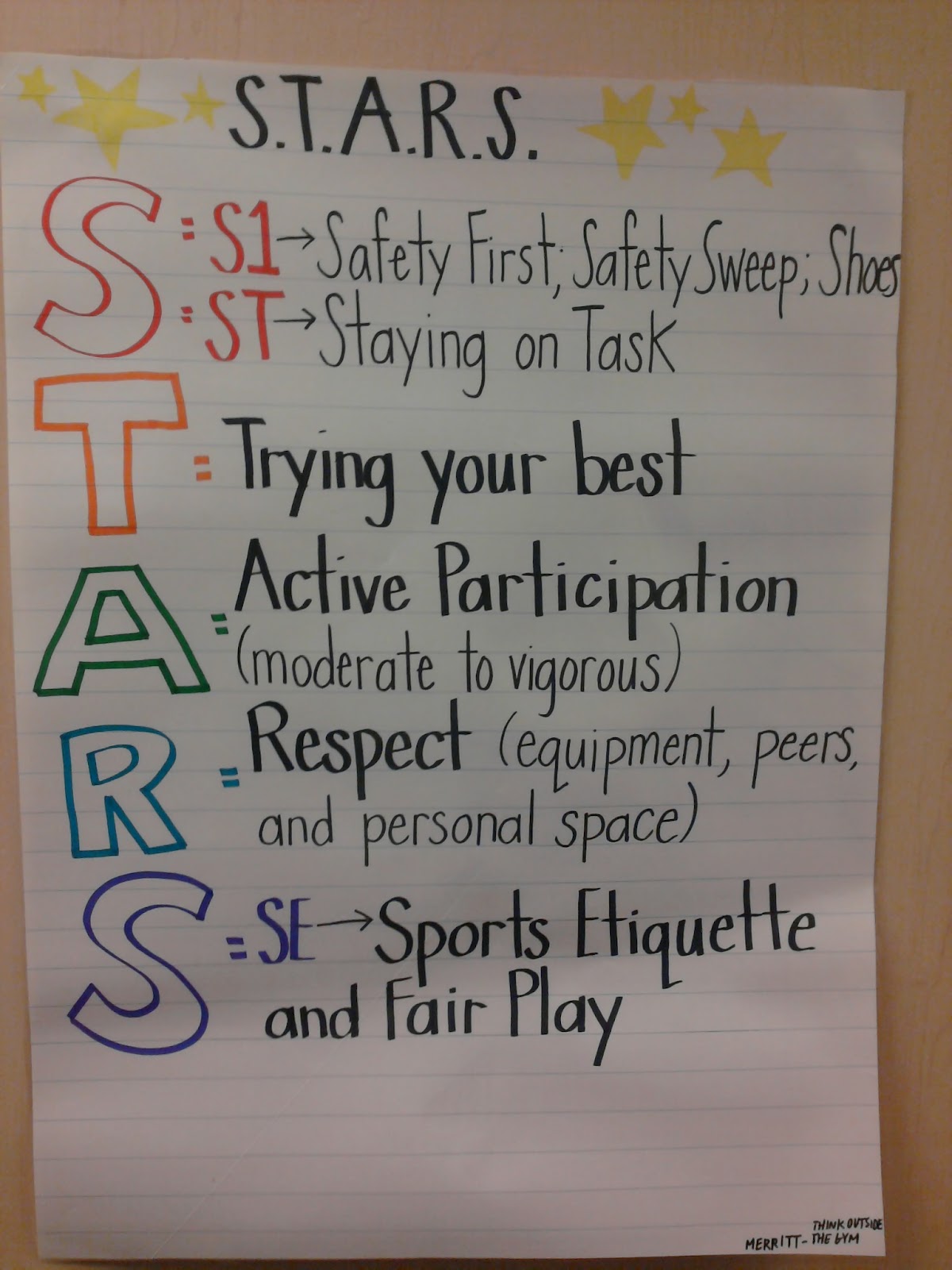
S.T.A.R.S. of Phys-ed!

S.T.A.R.S. Anchor Chart

S.T.A.R.S. originated from the TDSB.  Below is an anchor chart of the S.T.A.R.S. outline that can be posted for quick reference or when referring to a learning goal for the day.  For example, students are learning to participate safely in a sending activity.  Refer students to the S1 of the S.T.A.R.S. chart and then decide on success criteria for being safe (student generated of course).


SUCCESS CRITERIA ANCHOR CHART:
  • Make three labels: Active Living, Movement Competence, Living Skills
  • Divide chart paper into 3 sections
  • Laminate (if possible as balls, equipment will quickly tear down your anchor chart).
Dry Erase (laminated) Success Criteria Chart for longer  care.  If you need to refer back to this anchor chart in the future, take a picture and keep it in a TLCP binder (Teaching Learning Critical Pathways for HPE).


When creating success criteria with students, teachers often have no where to hang their posters (or no tape will stick to the wall!!!) or don't have a chalkboard or whiteboard in the gym.  

** Purchase Velcro strips from the dollar store. 
  • Attach to the back upper corners of laminated chart paper or thicker piece of paper.  
  • Next attach the Velcro to the wall.  
  • HINT: I always attach the fuzzy part to the wall because the rough part of the Velcro always picks up debris.
  • You can re-use the poster at the end of a learning cycle!