Pages

Showing posts with label TLCP. Show all posts

Thursday, May 2, 2013

Striking-Field TLCP: Intermediate

The TLCP outline for this unit was created with the needs of the students in mind at my school.  A big concern is the fact that students are still becoming accustomed with playing games and activities according to the Teaching Games for Understanding (TGFU) model.  The intermediate students still have a 'sport specific' mentality.  During this unit they were exposed to a variety of games...Change takes time for all of us :)

BIG IDEA:
Gr. 7: How do we safely and fairly devise and experiment with different strategies for better results in game situations?

Gr.8: How do we encourage others to participate safely and fairly in physical activities while experimenting with different rules?

LEARNING GOAL:
We are learning to understand the components of striking and fielding activities and apply sending and receiving skills and strategies while safely participating in games, while including others.
Striking-Fielding TLCP  (Daily Learning Targets are Listed in the Middle)
DAILY LEARNING TARGETS (Grade 7):
  1.  We are learning to follow and enforce proper safety guidelines to keep me and others safe.
  2. We are learning to make changes to games to include others and make it enjoyable.
  3. We are learning to strike a ball and shift my weight as I contact the ball and follow through in the intended direction to send it between or over opposing players.
  4. We are learning to hit or kick in different ways, varying the distance the object is sent, so that it wall be more difficult for opponents to field and return the object.
  5. We are learning to understand the basic game structures, rules, and guidelines of striking and fielding games.
  6. We are learning to apply the skills and strategies in striking and fielding games.
Learning Target #3: Movement Competence Striking Success Criteria (Generated by the students)
Use Ophea Resource from Gr.7 Striking-Fielding Lesson
Rubric generated using Learning Targets

FINAL TASK:

Application: 
You will participate in modified games of Striking and Fielding.  As you participate you will apply/demonstrate strategies and skills taught during the unit and demonstrate your safe and fair play.  As a team you will change up one rule from the original game of baseball and decide what strategies (offensively as the batter/base runner; defensively as the fielder).

Communication/Thinking & Inquiry:
·       You will complete an exit card to communicate your safe participation how you participated safely during striking/fielding games.
·       You will also complete a rule change and a strategy that you could working on connecting to the rule change you selected.

knowledge/Understanding:
·       On your exit card, you will explain your knowledge and understanding of the basic rules or components of striking and fielding games. 
Striking-Fielding Exit Card with Rubric Attached: Students

Wednesday, November 28, 2012

At the Heart of HPE are LIVING SKILLS!

GIVING STUDENTS "HoPE" IN H&PE
I just realized that the word HOPE is part of H&PE...I just changed the "&"  to a to a heart (or lower case "o" with a heart in the middle)!  

My question as a health & physical educator is how do I educate my students to build hope and confidence in themselves?  How do I create a safe and productive learning environment that builds personal and interpersonal skills that can be transferred to other curriculum areas?  How will I integrate the Living Skills on a daily basis?  Well, character building is an important part of the H&PE curriculum...we as teachers can give students HoPE in H&PE!

When we observe our students' needs we can drive our daily planning through encouraging Living Skills.  Below, I created a model of how I envision Living Skills impacting my teaching of the H&PE Curriculum and incorporating a continual cycle of planning, acting, assessing, observing and moving through this cycle of teaching with Living Skills at the heart of my planning.

LIVING SKILLS:
Personal Skills
Interpersonal Skills
Critical Creative Thinking Skills
Living Skills Impacting HPE Curriculum and  TLCP cycle
At the heart of H&PE is Living Skills.  Every expectation in the Ontario Curriculum is connected to a Living Skill.  

How are you making Living Skills a part of your H&PE program?


Friday, October 19, 2012

Net/Wall Activities and TLCP

*HPE Program Need:  Increasing critical thinking and allowing more student opportunities to speak the H&PE language using appropriate terminology in their thinking and communications; increasing student voice; allowing students to experience activities using a variety of equipment, playing a variety of games to reinforce strategies discussed.

Critical Thinking Questions for Net/Wall Games
*Critical Thinking Questions generated from Ophea's "Learn to Move - Fundamental Movement Skills" Cards (Net/Wall Card) or from Ontario H&PE Curriculum (look in specific grade under teacher prompts or living skills at the front of each grade section).
Posted in gym hallway during unit
*Can be used as exit card questions
*Allows students to be thinking about application when playing a variety of net/wall games and activities.

Net/Wall Activities-J/I Movement Competence Critical Thinking Questions

Net/Wall Activities-J/I Living Skills Critical Questions

Teaching Learning Critical Pathway for Net/Wall Activities (Junior/Intermediate)


Net/Wall-Junior TLCP


Net/Wall-Intermediate TLCP
Big Idea:
Intermediate Big Idea: How does failure allow you to gain success over your opponent in Net/Wall Activities? 


Junior Big Idea: How can you be a good example to others when participating in new and challenging net/wall games and activities?

Learning Goals: Linked to specific grade expectations in Living Skills, Active Living and Movement Competence Strands.

Tasks: (Basic ideas for students to demonstrate their learning) 1. Video conference with students (pre-assessment) using critical thinking questions based on living skills. 2. Movement Competence skills break down (demonstration and oral). 3. Application of grade specific strategies in net/wall activities. 4. Students completed a self-evaluation (included safety and active participation for progress reports).

Bump It Up: Focus on Strategies and their application in a game situation (this is a need in our classes this year).

Evaluation: Rubric included a student self-evaluation and an exit card question at the bottom (based on our critical questions).


***What are some of your 'Big Ideas' for Health & Physical Education?***


 It would be nice to gather some HPE big ideas that can be cross-curricular and even link to what teachers are doing in literacy!


Friday, August 31, 2012

S.T.A.R.S. of Phys-ed!

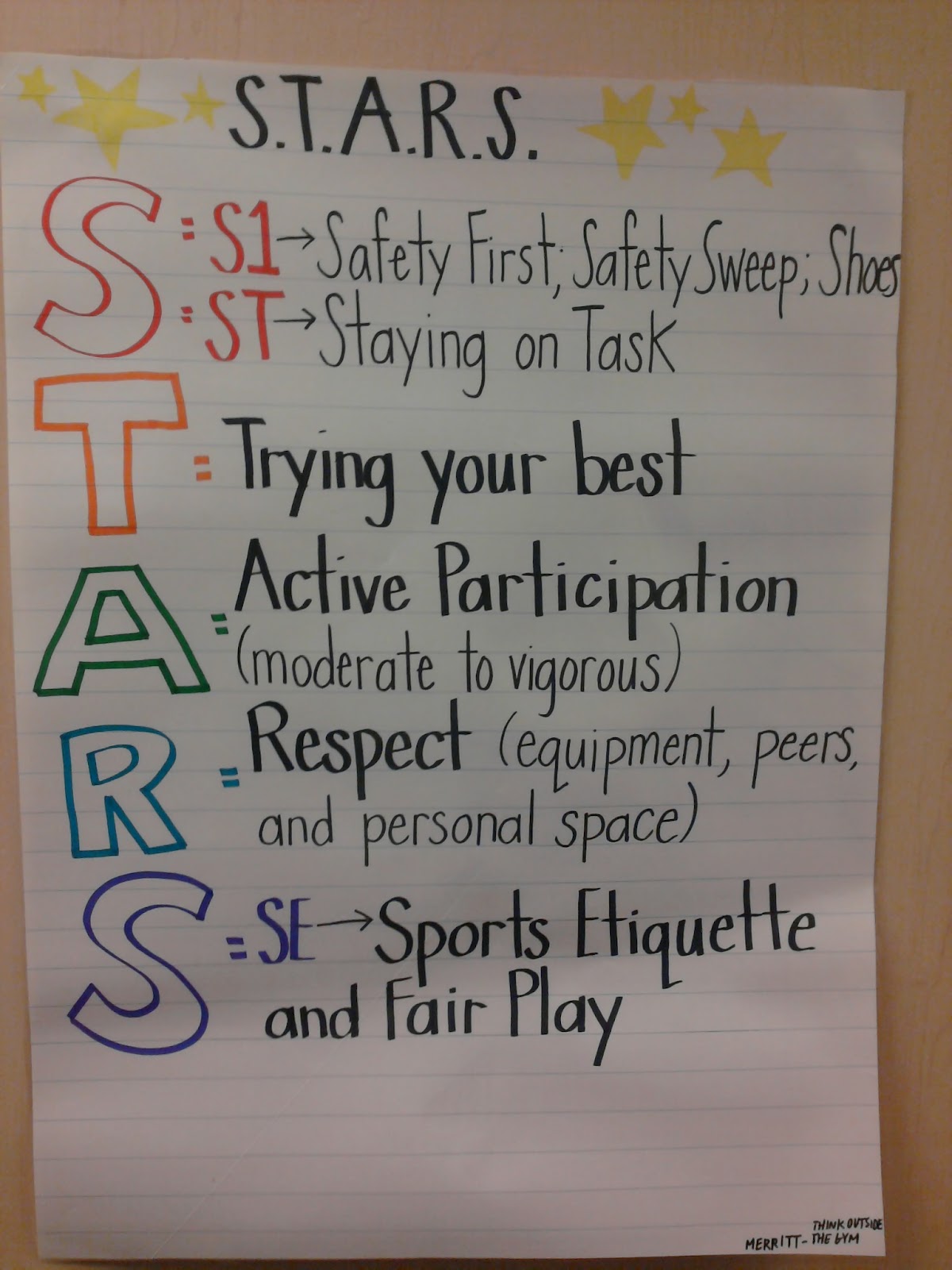
S.T.A.R.S. Anchor Chart

S.T.A.R.S. originated from the TDSB.  Below is an anchor chart of the S.T.A.R.S. outline that can be posted for quick reference or when referring to a learning goal for the day.  For example, students are learning to participate safely in a sending activity.  Refer students to the S1 of the S.T.A.R.S. chart and then decide on success criteria for being safe (student generated of course).


SUCCESS CRITERIA ANCHOR CHART:
  • Make three labels: Active Living, Movement Competence, Living Skills
  • Divide chart paper into 3 sections
  • Laminate (if possible as balls, equipment will quickly tear down your anchor chart).
Dry Erase (laminated) Success Criteria Chart for longer  care.  If you need to refer back to this anchor chart in the future, take a picture and keep it in a TLCP binder (Teaching Learning Critical Pathways for HPE).


When creating success criteria with students, teachers often have no where to hang their posters (or no tape will stick to the wall!!!) or don't have a chalkboard or whiteboard in the gym.  

** Purchase Velcro strips from the dollar store. 
  • Attach to the back upper corners of laminated chart paper or thicker piece of paper.  
  • Next attach the Velcro to the wall.  
  • HINT: I always attach the fuzzy part to the wall because the rough part of the Velcro always picks up debris.
  • You can re-use the poster at the end of a learning cycle!