Pages

Monday, May 13, 2013

"You Can...I Will" Character Cards - True Sport & Living Skills

Building character in today's schools can be nurtured in every classroom including Health & Physical Education.  Inspired from an idea on Pinterest, I created 16 "You Can...I Will" Character Cards.  The character cards are based on the monthly character assemblies at my school as well as paring each character trait with True Sports: Principles for Sport and Communities.


Double side each "You Can...I Will" Character Card.  Cut along the dotted line to create 'tabs'.  It will look like notices that are put up onto mailboxes.  These cards have been created for student use individually and in group discussions.  

The cards allow for student reflection and critical thinking about the 16 Character Cards.

More "leadership" and character education ideas on my Pinterest HPE School Leadership Board.


Saturday, May 4, 2013

Fitness Fortune Teller

There are so many examples like the link below, on how to make a "Fortune Teller" or as it was called when I was younger, a "Cootie Catcher".   

See some examples at the links below for other ideas to integrate literacy or numeracy (idea from Pinterest)

Deceptively Educational Blogspot has a sample Spelling Fortune Teller and outlines how to make it.

Fitness Fortune Teller
Here is how I made mine:  I used 4 of  Ophea's 50 Fitness Activities on the outside.  I also incorporated colours, numbers, shapes and when you flip open the fortune, there is a motivational quote for the students to read.

School in HWDSB have recently received Functional Fitness Circuit Charts from Thompson Publishing (Series: Physical Literacy for Elementary Schools)


Functional Fitness Chart IDEA using the Fitness Fortune Tellers:  Label each out side section of the fitness fortune as Fit Chart 1, Fit Chart 2, Fit Chart 3, Fit Chart 4.  Include repetitions in each section. Number the four selected Functional Fitness Circuit Charts 1, 2, 3, 4 and place one in each corner of your classroom, gym or outdoor space.  Student move around the space performing their activities in small groups of 3-4 students.  Each students gets a turn to try the Fitness Fortune Teller.  When the time is up, each students selects a motivational quote to read aloud (or read a site word or try math question).


Thursday, May 2, 2013

Striking-Field TLCP: Intermediate

The TLCP outline for this unit was created with the needs of the students in mind at my school.  A big concern is the fact that students are still becoming accustomed with playing games and activities according to the Teaching Games for Understanding (TGFU) model.  The intermediate students still have a 'sport specific' mentality.  During this unit they were exposed to a variety of games...Change takes time for all of us :)

BIG IDEA:
Gr. 7: How do we safely and fairly devise and experiment with different strategies for better results in game situations?

Gr.8: How do we encourage others to participate safely and fairly in physical activities while experimenting with different rules?

LEARNING GOAL:
We are learning to understand the components of striking and fielding activities and apply sending and receiving skills and strategies while safely participating in games, while including others.
Striking-Fielding TLCP  (Daily Learning Targets are Listed in the Middle)
DAILY LEARNING TARGETS (Grade 7):
  1.  We are learning to follow and enforce proper safety guidelines to keep me and others safe.
  2. We are learning to make changes to games to include others and make it enjoyable.
  3. We are learning to strike a ball and shift my weight as I contact the ball and follow through in the intended direction to send it between or over opposing players.
  4. We are learning to hit or kick in different ways, varying the distance the object is sent, so that it wall be more difficult for opponents to field and return the object.
  5. We are learning to understand the basic game structures, rules, and guidelines of striking and fielding games.
  6. We are learning to apply the skills and strategies in striking and fielding games.
Learning Target #3: Movement Competence Striking Success Criteria (Generated by the students)
Use Ophea Resource from Gr.7 Striking-Fielding Lesson
Rubric generated using Learning Targets

FINAL TASK:

Application: 
You will participate in modified games of Striking and Fielding.  As you participate you will apply/demonstrate strategies and skills taught during the unit and demonstrate your safe and fair play.  As a team you will change up one rule from the original game of baseball and decide what strategies (offensively as the batter/base runner; defensively as the fielder).

Communication/Thinking & Inquiry:
·       You will complete an exit card to communicate your safe participation how you participated safely during striking/fielding games.
·       You will also complete a rule change and a strategy that you could working on connecting to the rule change you selected.

knowledge/Understanding:
·       On your exit card, you will explain your knowledge and understanding of the basic rules or components of striking and fielding games. 
Striking-Fielding Exit Card with Rubric Attached: Students

Thursday, April 11, 2013

Personal Fitness Performance Appraisal

Middle School Students completing their personal fitness goals for the third time.  
September: Pre-assessment - Students are getting to know where they are at in terms of their own personal fitness. Students perform activities under each fitness component (see picture below).  

October: Post-Assessment: Students perform their fitness stations a second time (with their baseline data from September in mind) and then set short term S.M.A.R.T. goals for Term 1...

Re-visit goal setting on an on-going basis in a students HPE portfolio throughout the year: Students reflect on their performances and look directly at their own results for strengths, areas for improvement, and growth in all fitness component areas.

January: Term 1 Personal Fitness Performance Appraisal

April:  Term 2 Personal Fitness Performance Appraisal

End of May: Final Goal Setting Task.  Students will reflect on their learning from the whole year (depending on grade specific expectations for 7 and 8's). 


Thursday, April 4, 2013

Beep Test

As part of our Junior/Middle school Personal Fitness Performance Appraisal, the Beep Test is one of many cardio-respiratory endurance activities I have students perform to set personal goals to improve personal fitness throughout the year.

The Run For Life Website has a video demonstrating the 20 metre shuttle run and also has the audio for running the beep test in the link below:

http://www.runforlife.ca/schools/staff-room/beep-test/

"The Beep Test is used throughout the world to evaluate aerobic fitness.  Participants must run 20 metres back and forth resting between sounds from the audio.  The test is over when the participants can no longer keep up to the pace of the beep."

Differentiation:  In September I have students to select running the beep test from a 10m, 15m, or 20 m line.  After their initial beep test, they can then set a goal to stay at the selected distance, move up or down.  They can then feel their own personal success at the desired LEVEL / SHUTTLE and can also set a level/shuttle goal.

Wednesday, February 27, 2013

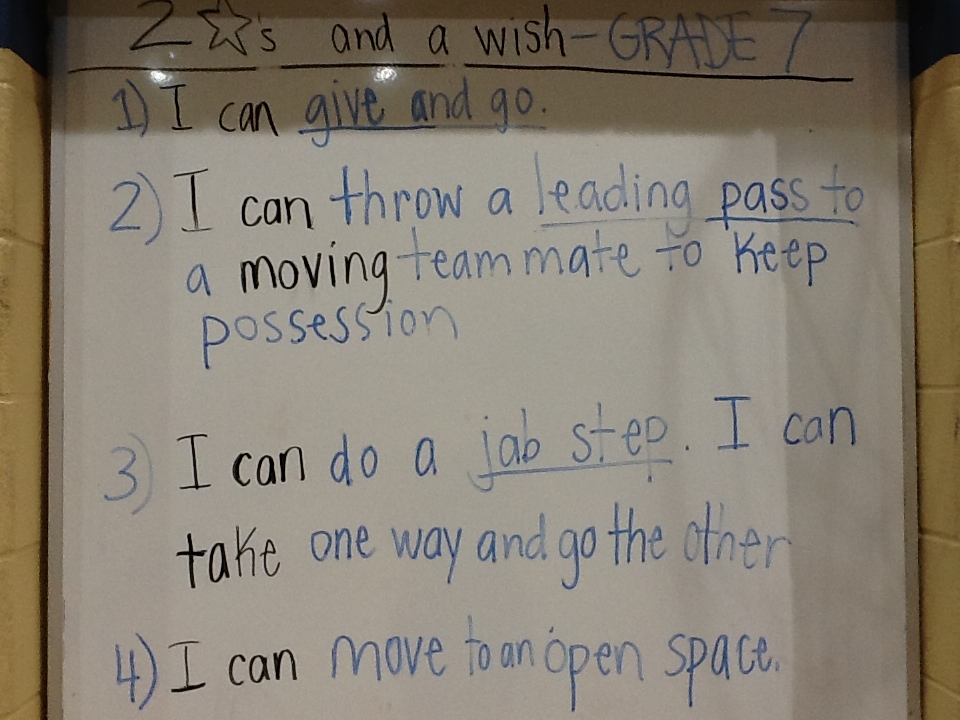
Invasion Games-Intermediate: Two Stars and a Wish

"Two Stars and a Wish" or "Two Hoops and a Swish"

Grade 7 & 8: I made a list of strategies we were working on during our indoor Invasion Territory Unit. These are from the H&PE Ontario Curriculum.


I modelled the 3-4 strategies (see pictures above), specific to the grade being taught and had students evaluate me using thumbs up, side, or down when I performed each strategy.  I  demonstrated the strategies so students could 'evaluate' my strengths (stars or 'hoops') and where my areas for improvement were (wish or 'swish').  They then came up with an overall decision on what my 'wish' should be.

Now at the end of the Invasion Unit, students are deciding what their strengths are in terms of strategies and selecting at least one area they would like to improve (i.e., 'wish or swish') according to their own assessment of themselves.  For example, this unit we have provided students a wide variety of activities to practise and apply taught skills and strategies.  Some activities include scooter hockey, ultimate chicken, scoop ball, soccer, basketball, hoopster, floorball, etc.  

Next Steps:  Students will complete an exit card and critically think about their own strengths and 'wish' at the end of this unit.


Friday, February 15, 2013

Health: "iTune Out Drugs"

Pintrest inspired Bulletin Board....Grade 6, 7, 8 Health Ideas for Substance Use, Addictions and Other Related Behaviours

:  


Grade 6:

C1.1 describe the range of effects associated with using cannabis and other illicit drugs (e.g. crack, cocaine, Ecstasy, crystal methamphetamine) and intoxicating substances (eg..,g gas, glue, prescription medications)
C1.2 identify people and community resources (e.g., elders, family members, community agencies, churches, mosques, synagogues, public health units, telephone help lines, recreation facilities

"You have been hired to design a Drug Awareness Brochure, “iTune Out Drugs”, to educate other kids about the dangers of using Drugs and other Substances – specifically cannabis (grade 6)!"

Grade 7:
EXPECTATIONS:
C1.Understanding Health Concepts: C1.2 Mental Health, substances, supports
C2. Making Healthy Choices: C2.3 Body Image, substances use
C3. Making Connections for Healthy Living: C3.2 Implication of substances use and addictions

Grade 7/8 Scenario:
"A group of friends are texting to one another about  getting together next weekend and it is ‘known’ that there might be drugs  at the get-to-gether.
You have been texting your friends all weekend and the group is trying to decide what to do.  Some of your friends are pressuring you to come out next weekend to hang, maybe watch a movie.  Your parents don’t really know a couple of friends who are new to the group and you’ve heard..."

Write out what your texting conversation might look like.
_______________Texter 1:  Makes a Bad decision
_______________Texter 2: Makes a Good decision
_______________Texter 3: Pressures Group to do drugs
_______________Texter 4: Knows/texts who to go to for help and support
_______________Texter 5: Undecided: To do drugs or not
_______________Texter 6: Aware of body image as being poor or good (choice)


Grade 8:
EXPECTATIONS:
C1.Understanding Health Concepts:  C1.3 Warning Signs, consequences
C2. Making Healthy Choices: C2.3 Mental Health, stress management

Write out what your texting conversation might look like.
____________________Texter 1:  Stressed Out…
____________________Texter 2: Pressure into doing something  one or more people don’t want to do
____________________Texter 3: Undecided
____________________Texter 4: Absolutely not want to get involved in Substance use
____________________Texter 5: Visible mental Health situation
____________________Texter 6: Encourages support from someone/some place